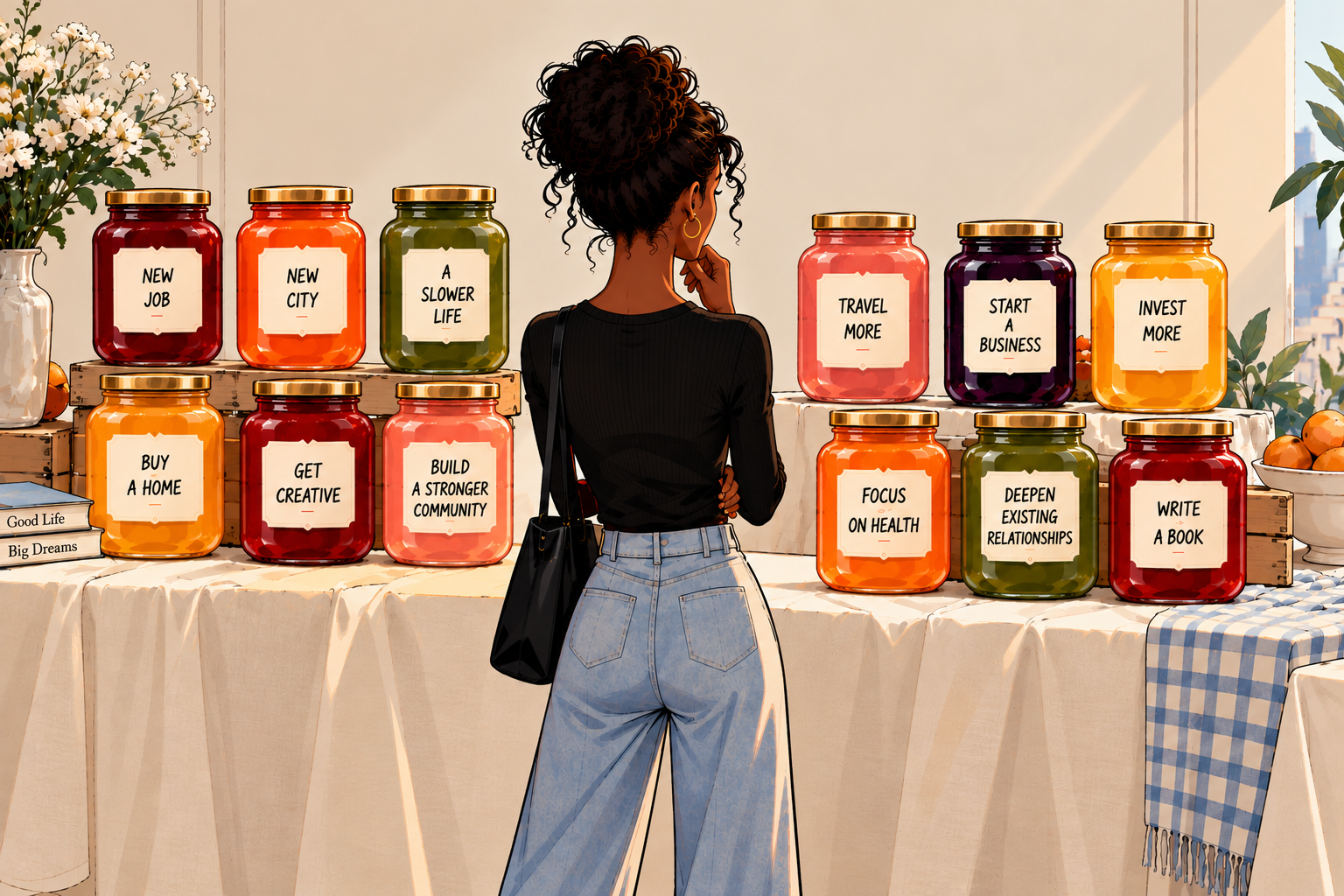
I have spent most of my adult life getting very good at what’s next, and for the most part, this has been an excellent strategy.
For six years, I taught middle and high school science in Brooklyn. Then, I decided I wanted to understand business, so I went to Columbia Business School, interned at Goldman Sachs, landed at McKinsey, and eventually found my way into VC and entertainment. Somewhere in between all of that, I visited more than 75 countries.
I am not about to tell you ambition is bad. As a Jamaican? God forbid.
I love options. Options changed my life!
But lately I’ve been thinking about what happens when you get too comfortable in knowing that you have them.
My twenties had one six-year professional chapter. Since then, my career has come in roughly two-year installments: business school, consulting, and entertainment thus far.
I don’t regret any of those moves, but I think all of that movement got me used to thinking about my life in chapters. I’ve even moved 6 times in the past 6 years. Even when I liked where I was, part of me was usually thinking about where it might lead. The weird side effect is that your actual life can start to feel temporary.
We have become very good at preparing for what’s next.
There is a psychology study that I first learned about in undergrad that came to mind recently. When I Googled “jam study” to refresh my memory, I realized one of the researchers was Prof. Sheena Iyengar, whose class I took at Columbia Business School.
I loved her class, including the jokes she would casually make about her own blindness that I would laugh too hard at. I live for self-deprecating humor.
Anyway, back to the jam.
In the mid-1990s, social psychologists Sheena Iyengar and Mark Lepper set up a jam-tasting display in a California grocery store. On some days, shoppers saw 24 flavors; on others, they saw six.
The larger display attracted more people, but the smaller one was much better at getting them to buy something. Nearly 30% bought a jar when choosing from six options, compared with about 3% when choosing from 24. We say we want more options, but sometimes having more of them makes it harder to choose anything at all. The study became famous as an example of “choice overload.” The research since then is more complicated than more options = bad, which isn’t really my point anyway.
Sometimes I wonder whether we are doomscrolling real life.
Don’t like your job? LinkedIn. Nothing interesting happening tonight? Partiful. Want to become an entirely different person by Monday? 5,000,000 people on the internet have already made you a 14-step daily routine.
It is increasingly easy to find evidence that another option exists and you should take it.
I’m not sure if we’re good at deciding when we have enough.
Most of my pivots were not dramatic exits from things I hated. Usually, I saw something I wanted to explore and went toward it, but I’m beginning to think there are seasons when a better question is: what here is worth deepening?
Getting more out of your life and going deeper into it are not necessarily the same thing.
I have spent years learning that I am allowed to change my mind, leave, pivot and refuse to remain loyal to an old version of myself just because I spent a long time becoming her.
I know that routine pretty well.
What I am less practiced at is letting something good enough stay long enough to become important.
I have friendships that matter because we have accumulated years of context about one another. Even working on this little project feels different when I think about it as something I might still be doing years from now rather than another project I am trying for a few months.
You can’t compound what you keep restarting.
A surprising number of the things I want now—deeper friendships, a stronger sense of community, partnership, mastery, a body of work I am proud of—require time with the same people, places, things, and ideas.
I still want to know what else is possible. I just don’t want knowing that I could do something else to make everything I am already doing feel provisional.